
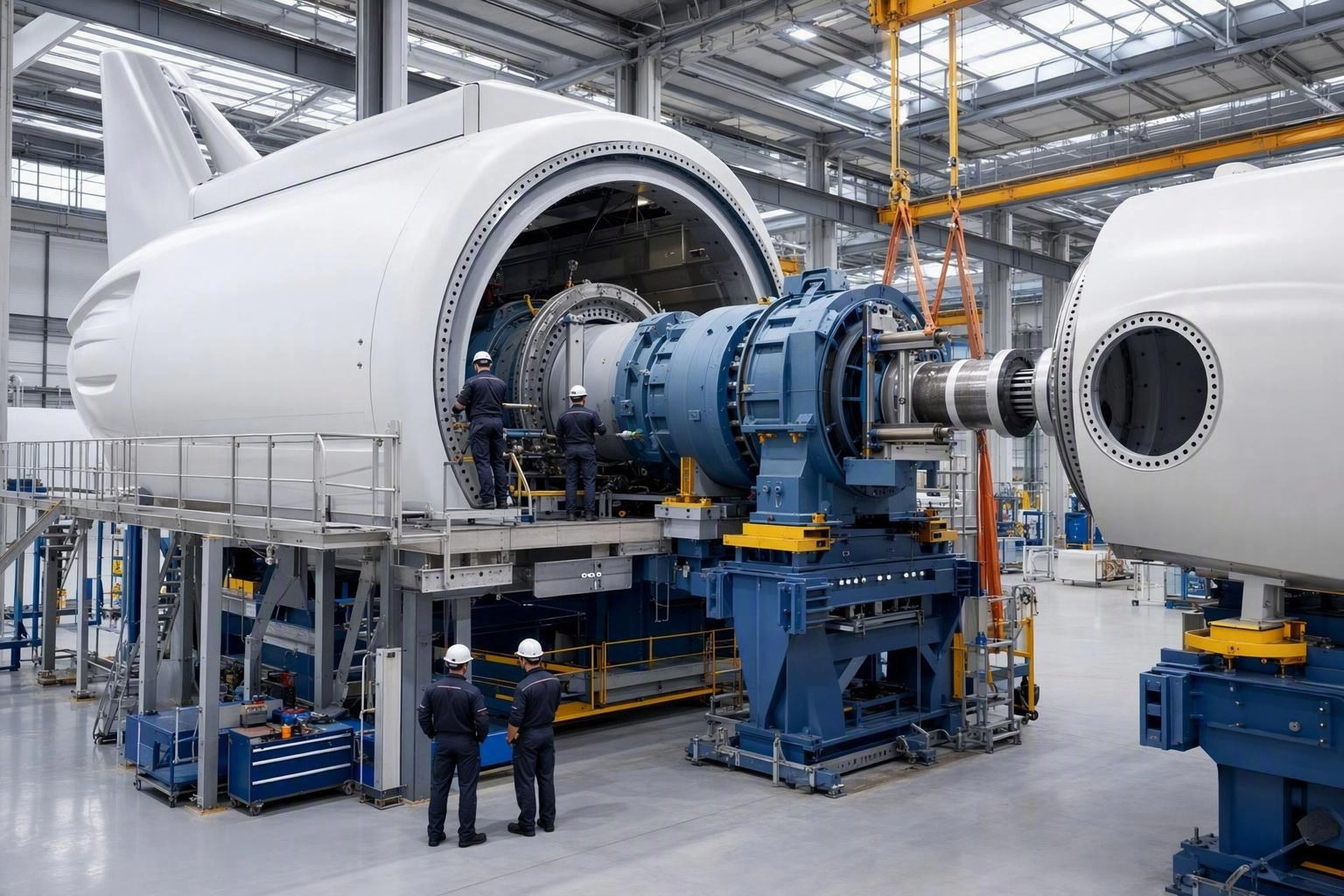
Why Wind Power Sets a Different Standard
A wind turbine is expected to operate for twenty years or more, with maintenance access that is expensive onshore and extremely expensive offshore. Every component inside the nacelle is therefore evaluated on lifetime cost rather than purchase price. For the wire used in the generator and in the nacelle's auxiliary systems, that changes the specification conversation entirely.
The result is that wind applications tend to specify a higher thermal class and a more conservative insulation build than equivalent industrial machines, even when the calculated operating temperature would not require it.
The Operating Conditions That Drive the Specification
Continuous vibration and mechanical cycling
A turbine generator is never truly at rest. Blade loading varies continuously, and the whole drivetrain experiences low frequency vibration plus higher frequency components from the gearbox and bearings. Winding insulation must resist abrasion between turns over millions of cycles, which places emphasis on surface hardness and adhesion rather than dielectric strength alone.
Thermal cycling across a wide range
Nacelle temperatures can vary from well below freezing to extremely high internal temperatures when the generator is under full load in strong wind. Repeated expansion and contraction of copper against insulation stresses the bond between coating layers. Insulation systems with good adhesion after thermal ageing perform better in this regime than systems optimised purely for high breakdown voltage.
Moisture and salt exposure offshore
Offshore installations face humidity and salt-laden air. Although the generator is enclosed, the enclosure breathes as it heats and cools. Insulation systems with better resistance to hydrolysis and to tracking are preferred, and moisture-related insulation resistance testing becomes a routine part of acceptance.
Maintenance inaccessibility
The most important driver is simply that failures are extremely costly to repair. A wire grade that costs slightly more per kilogram but reduces the probability of a winding failure over twenty years is easily justified.
Insulation Grades Typically Specified
| Position | Typical class | Reason |
|---|---|---|
| Main generator stator winding | 200–240 | Long life expectation, high load factor, limited cooling access |
| Pitch and yaw drive motors | 155–180 | Intermittent duty but wide ambient range |
| Hydraulic and cooling pumps | 155–180 | Continuous duty in a confined nacelle |
| Brake and safety systems | 180–200 | High reliability, infrequent but critical operation |
What to Verify in the Test Report
- Thermal class confirmation by recognised accelerated ageing method, not by marketing description.
- Adhesion after ageing, since this predicts behaviour under thermal cycling better than as-received adhesion.
- Flexibility and elongation, because forming stresses the coating before the machine ever runs.
- Dielectric strength at elevated temperature, not only at ambient.
- Abrasion resistance, relevant to any winding exposed to vibration over a long service life.
- Batch consistency, since a single inconsistent lot can compromise an entire generator.
The Case for Conservative Specification
It is tempting to specify the minimum thermal class that satisfies a thermal model. In wind applications this is usually the wrong instinct. Design margins are eroded over twenty years by factors that are hard to model: partial discharge from converter waveforms, gradual loss of cooling efficiency as ducts accumulate debris, and occasional overload events during grid disturbances.
A common and defensible approach is to specify one thermal class above the calculated requirement for the generator winding, accepting a modest price premium in exchange for a meaningfully lower probability of a costly intervention.
Rectangular and Flat Conductor Trends
As turbine ratings increase, designers seek higher slot fill to reduce machine size and improve efficiency. Rectangular enameled wire allows more copper in a given cross-section, which is attractive when the generator must fit inside an existing nacelle envelope. The trade-off is manufacturing complexity: flat conductors demand tight dimensional tolerance and excellent insulation adhesion because forming stresses are concentrated at the corners.
Manufacturing Capability for This Sector
Huaya Fa supplies enameled copper, aluminium and copper-clad aluminium wire in round and rectangular profiles, covering class 130 to class 240, with round wire from 0.03 mm to 3.50 mm and rectangular wire to specification. Two production bases and approximately 3,000 tonnes monthly capacity support multi-year programme supply, with ISO 9001 and ISO 14001 certification and RoHS and REACH compliance.
For wind programmes we recommend agreeing test protocols and sampling frequency before the first shipment, because the acceptance criteria in this sector are usually stricter than general industrial practice.


