
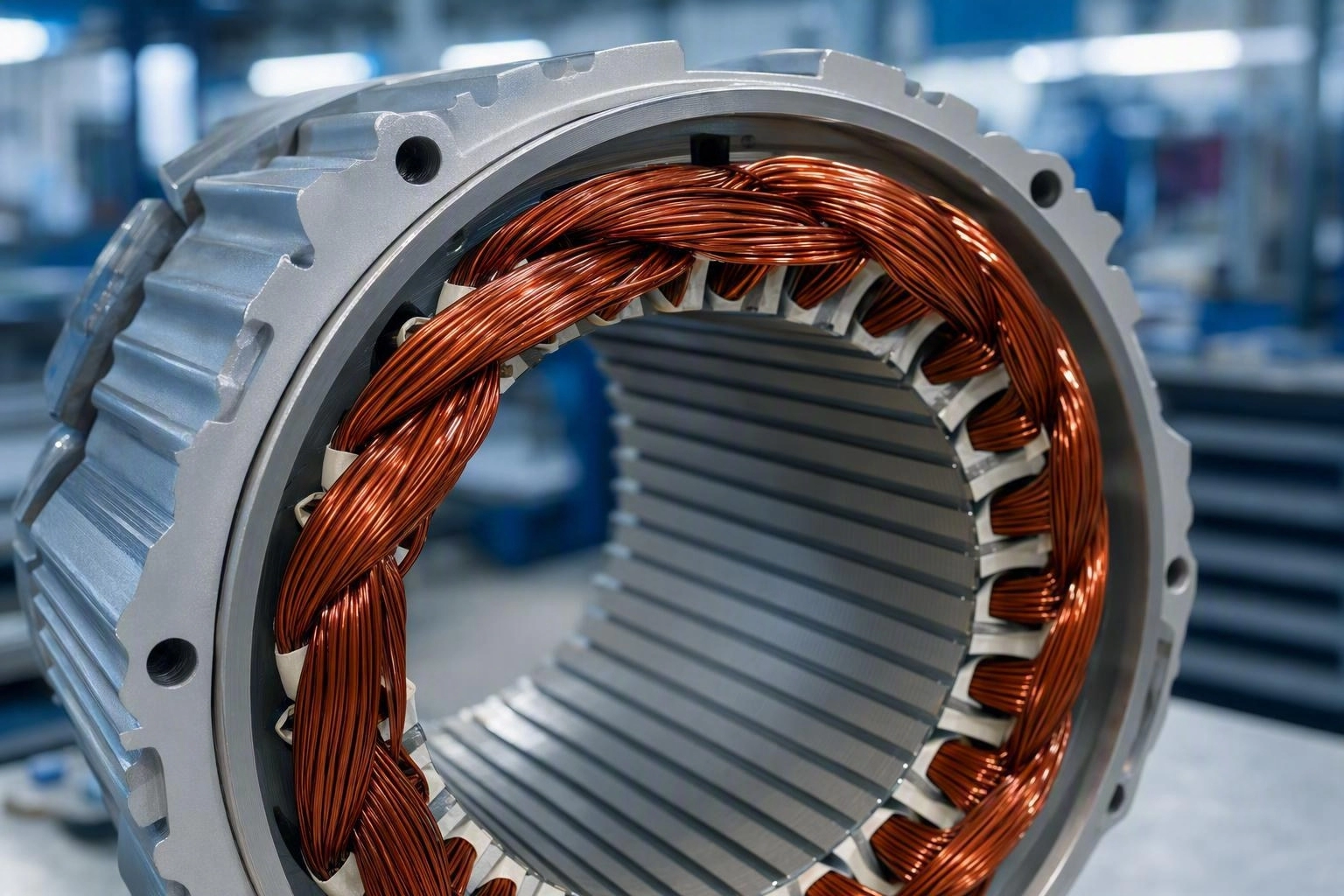
Why Traction Motors Are the Hardest Magnet Wire Application
An electric vehicle traction motor is not simply a larger version of an industrial motor. It operates under a combination of conditions that no other application reproduces at the same time: wide ambient temperature swings, continuous high-frequency switching, very high rotational speed, and a service life expected to match the vehicle itself. For the winding engineer, this means the enameled wire inside the stator becomes a limiting component rather than a commodity input.
This article sets out how insulation grade, conductor profile and process control interact in a traction motor, and what buyers should demand from a magnet wire supplier before releasing a specification.
The Three Failure Modes That Define the Specification
1. Thermal ageing of the insulation
Copper losses and iron losses generate heat directly inside the winding, where it is hardest to remove. Insulation that softens or embrittles under sustained heat loses dielectric strength and eventually fails turn to turn. The thermal class of the enamel therefore sets the practical ceiling for how hard the motor can be pushed.
In practice, traction motors are designed with a winding hot-spot target that leaves margin against the rated class. A common approach is to specify class 200 or class 240 wire even when the calculated continuous hot spot sits near 180 °C, because overload events and inverter ripple are difficult to predict precisely in the design phase.
2. Partial discharge under inverter drive
Modern drives use pulse width modulation, which produces very steep voltage edges. Reflected wave effects inside the winding can create local voltage spikes several times higher than the DC bus voltage. Where these spikes exceed the partial discharge inception voltage of the enamel, small discharges begin to erode the coating from the inside.
The visible result is a distinctive failure pattern: pitting on the wire surface, often concentrated on the first and last turns of a phase, with no obvious external damage. This is why inverter duty motors increasingly specify corona resistant insulation rather than relying on a thicker conventional coating.
3. Mechanical stress from high speed and slot fill
At high rotational speed, centrifugal force acts on the winding, and thermal cycling causes repeated expansion and contraction. Where slot fill is tight, the wire is already mechanically loaded during insertion. Abrasion resistance and adhesion between coating layers matter as much as dielectric strength in these conditions.
Insulation Systems Commonly Specified
| Insulation system | Thermal class | Typical traction motor role |
|---|---|---|
| Polyurethane (UEW) | 130–180 | Low voltage auxiliary motors, small actuators, sensors |
| Polyester / Polyester-imide | 155–180 | Cost-driven auxiliary and ancillary drives |
| Polyamide-imide (AIW / PIW) | 200–240 | Main traction stator windings, high overload margin |
| Polyimide (PIW, QY) | 240 | Extreme temperature zones, aerospace-adjacent duty |
| Corona resistant composite | 200–240 | Inverter duty stators, hairpin and round wire alike |
Conductor Profile: Round Wire, Hairpin or Flat
Round wire remains the default for wound stators because it is flexible, well understood and inexpensive to process. Its limitation is slot fill: round strands leave void space that reduces the amount of copper that can be packed into a given slot.
Rectangular or flat enameled wire addresses this directly by filling the slot cross-section more completely. Higher slot fill means more copper in the same envelope, which translates into higher efficiency and better thermal performance. The trade-off is a more demanding manufacturing route, because forming, insertion and welding of rigid rectangular conductors require tighter tolerances and better insulation adhesion.
- Round enameled wire — flexible, mature process, suited to most wound stators and auxiliary machines.
- Rectangular enameled wire — maximum slot fill, best efficiency per unit volume, used in high-performance drive motors.
- Self-bonding variants — the coating fuses adjacent turns during heat treatment, adding mechanical rigidity without a separate impregnation step.
Sourcing Checklist for Traction Motor Wire
- Declare the thermal class explicitly, and confirm it with a test report rather than a catalogue label.
- Ask how corona resistance was qualified — partial discharge inception voltage data is more useful than a general claim.
- Check dimensional tolerance on the enamel build, because slot fill calculations depend on the outer diameter, not the bare conductor.
- Confirm adhesion and flexibility results after elongation and after thermal shock, not only on as-received samples.
- Verify batch traceability so that a defect found in the field can be traced back to a production lot.
How Quality Is Verified at the Wire Stage
A traction motor supplier cannot inspect its way to reliability if the incoming wire is inconsistent. The measurements that matter at the wire level are pinhole count and continuity, enamel thickness and concentricity, elongation and tensile strength, adhesion after elongation, and dielectric breakdown voltage. For inverter duty grades, partial discharge testing at elevated temperature adds a further layer of confidence.
Wire produced with continuous in-line gauging, closed-loop enamel viscosity control and recorded curing temperatures gives the motor builder a stable input. Where these controls are absent, variation appears later as scrap, rework or field returns.
Where Huaya Fa Fits
Huaya Fa manufactures enameled round and rectangular wire across the thermal range from class 130 to class 240, covering copper, aluminum and copper-clad aluminum conductors. Production runs at two bases, with a standard range from 0.03 mm to 3.50 mm for round wire, supported by ISO 9001 and ISO 14001 certification and compliance with RoHS and REACH requirements.
For traction motor programmes we recommend early involvement at the specification stage. Allowing the wire grade and conductor profile to be fixed together with the winding design avoids the common situation where a motor is designed around a wire that cannot be supplied to the required tolerance at volume.
Related questions we are asked
Can a lower thermal class wire be used if the duty cycle is light? Yes, provided the calculated hot spot leaves margin and the inverter waveform has been assessed for partial discharge risk. Both conditions should be documented.
Is thicker enamel always better? No. Thicker builds reduce slot fill and can lower flexibility. The correct build is the one that meets dielectric requirements at the lowest practical thickness.
Does conductor choice affect efficiency claims? Yes. Slot fill and conductor conductivity both feed directly into efficiency, which is why aluminium and copper-clad aluminium are usually considered for cost-sensitive or weight-sensitive designs rather than for maximum efficiency targets.


