
Why This Decision Keeps Coming Back
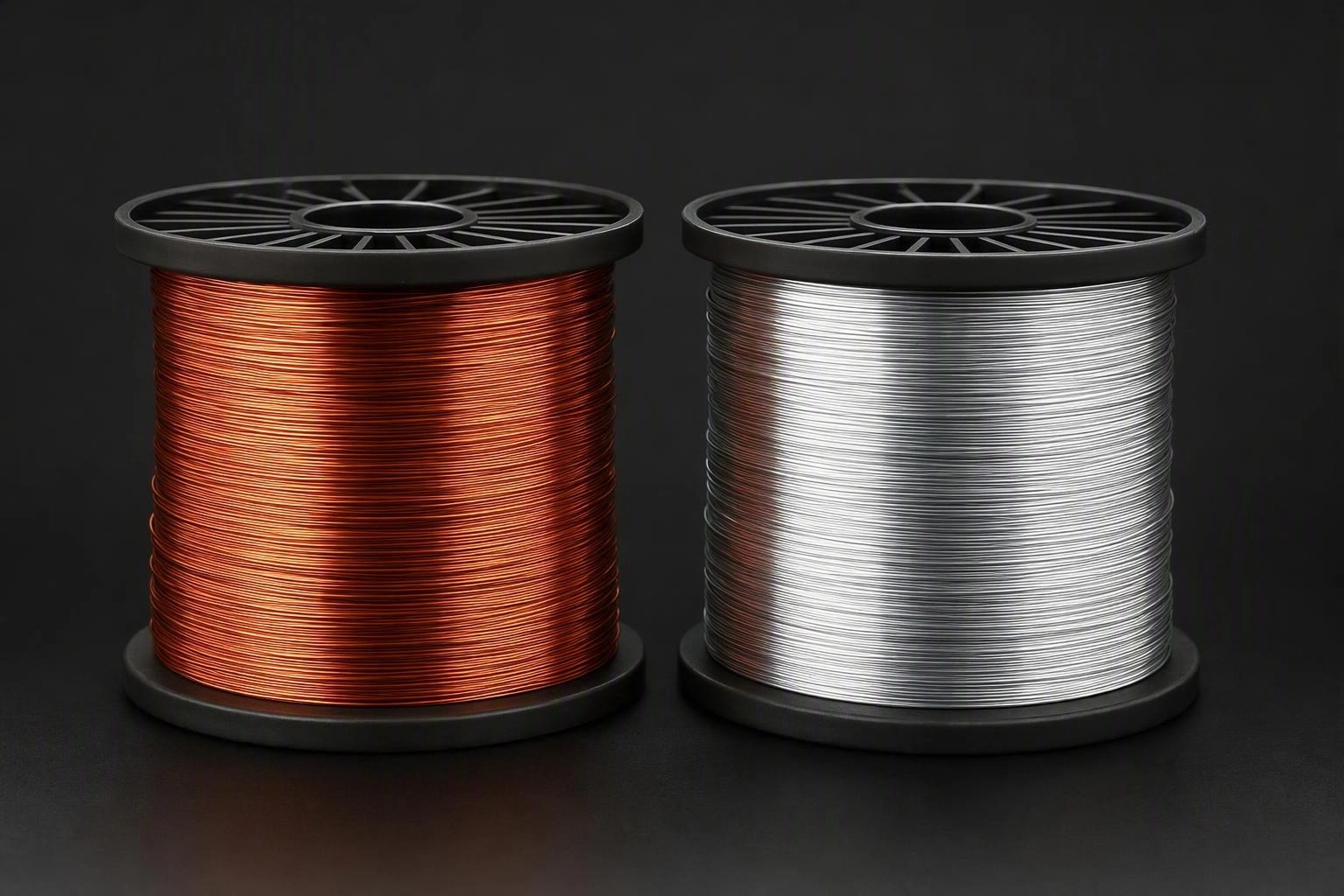
Copper has been the default conductor for magnet wire for over a century, and for good reason. It offers the highest practical conductivity, it terminates easily, and its behaviour is thoroughly understood. But copper prices are volatile, copper is heavy, and in many applications the conductivity requirement is not actually at the limit of what copper can offer.
That combination has brought aluminium and copper-clad aluminium back into serious consideration. The question is not which conductor is best in the abstract, but which conductor matches the electrical, mechanical and commercial requirements of a specific winding.
Material Comparison at a Glance
| Property | Copper | Aluminium | Copper-clad aluminium |
|---|---|---|---|
| Relative conductivity | 100% (reference) | About 61% of copper by volume | Intermediate, set by copper volume fraction |
| Density | 8.96 g/cm³ | 2.70 g/cm³ | Between the two, typically near aluminium |
| Conductivity per unit weight | Reference | Highest of the three | High, above copper |
| Cost per unit weight | Highest and most volatile | Lowest and more stable | Below copper, above aluminium |
| Solderability | Excellent | Difficult without special process | Good, copper skin is solderable |
| Termination | Straightforward | Requires oxide management and specific methods | Simpler than aluminium, still not copper-equivalent |
| Mechanical strength | High | Lower, softer | Between the two |
Where Aluminium Makes Sense
Aluminium has roughly a third of the density of copper. For a given resistance, an aluminium conductor must be larger in cross-section, but it is still significantly lighter. This makes aluminium attractive in three situations:
- Weight-critical designs, where reducing mass improves system efficiency or structural load.
- Cost-sensitive windings, where a modest efficiency penalty is acceptable in exchange for a substantially lower material cost.
- Transformer and inductor windings, where larger cross-sections are practical and weight savings matter.
The requirement to increase cross-section is the key constraint. Because aluminium needs more area for the same resistance, the slot must accommodate a larger conductor. Where slot space is already tight, aluminium may simply not fit.
Copper-Clad Aluminium: The Middle Path
Copper-clad aluminium wire consists of an aluminium core with a metallurgically bonded copper skin. The copper provides a conductive and solderable outer surface, while the aluminium core reduces weight and cost. The result is a conductor that behaves more like copper at the surface and more like aluminium in bulk.
This is especially useful where termination quality matters. Because the outer layer is copper, conventional soldering and welding techniques can often be applied, avoiding the extra process development that pure aluminium demands. The proportion of copper in the cross-section determines both the conductivity and the cost, so CCA grades should always be specified by copper volume fraction rather than by a general description.
The Reliability Question
Aluminium-based conductors have a history of scepticism, some of it earned in the era when aluminium building wire was used with termination methods designed for copper. Modern aluminium and CCA magnet wire performs well when three conditions are respected:
- Terminations are designed for aluminium, including oxide removal, appropriate jointing technique and correct contact pressure.
- Thermal expansion is accounted for, because aluminium expands more than copper and repeated cycling can loosen joints that were not designed for it.
- Environmental exposure is controlled, since aluminium oxide formation and galvanic effects need to be managed.
Where these conditions are met, aluminium and CCA windings deliver acceptable service life in many auxiliary and cost-driven applications. Where they are ignored, problems appear at the termination rather than in the winding itself.
A Practical Selection Framework
- Maximum efficiency or minimum size required? Choose copper. Its conductivity per unit volume is the highest, so it produces the smallest machine for a given loss target.
- Minimum weight required? Consider aluminium or CCA, accepting a larger conductor cross-section.
- Minimum cost with acceptable performance? Aluminium is the cheapest option; CCA offers better termination behaviour at slightly higher cost.
- Solderability required in a low temperature process? Copper or a polyurethane-grade CCA with a solderable enamel.
- Harsh environment with vibration? Copper remains the safest choice, because its mechanical strength and fatigue behaviour are best understood.
Availability and Specification
Huaya Fa produces enameled copper round wire, aluminium round wire, copper-clad aluminium wire and rectangular profiles, with insulation grades from class 130 to class 240. Round wire is supplied from 0.03 mm to 3.50 mm, covering the range in which conductor substitution decisions are most commonly made.
When requesting a quotation for aluminium or CCA wire, specify the copper volume fraction for CCA, the required thermal class, the enamel type and the conductor tolerance. These four parameters determine whether the wire will meet the electrical target once it is wound into the actual machine.
Frequently raised concerns
Does CCA wire corrode at the termination? The copper skin limits galvanic exposure, but joint design still matters. Sealed or plated terminations are recommended in humid environments.
Can aluminium wire be used in the same winding machine? Usually yes, with attention to tension control, because aluminium is softer and more prone to stretching.
Is efficiency always worse with aluminium? For the same slot volume, yes. Efficiency can be partly recovered by increasing cross-section where slot space allows.


