
Why Standards Exist and What They Do Not Do
International standards for winding wire give manufacturers and buyers a shared vocabulary. They define dimensions, test methods and acceptance criteria so that a specification written in one country can be understood and met in another. That is genuinely valuable, and buyers should insist on standards compliance.
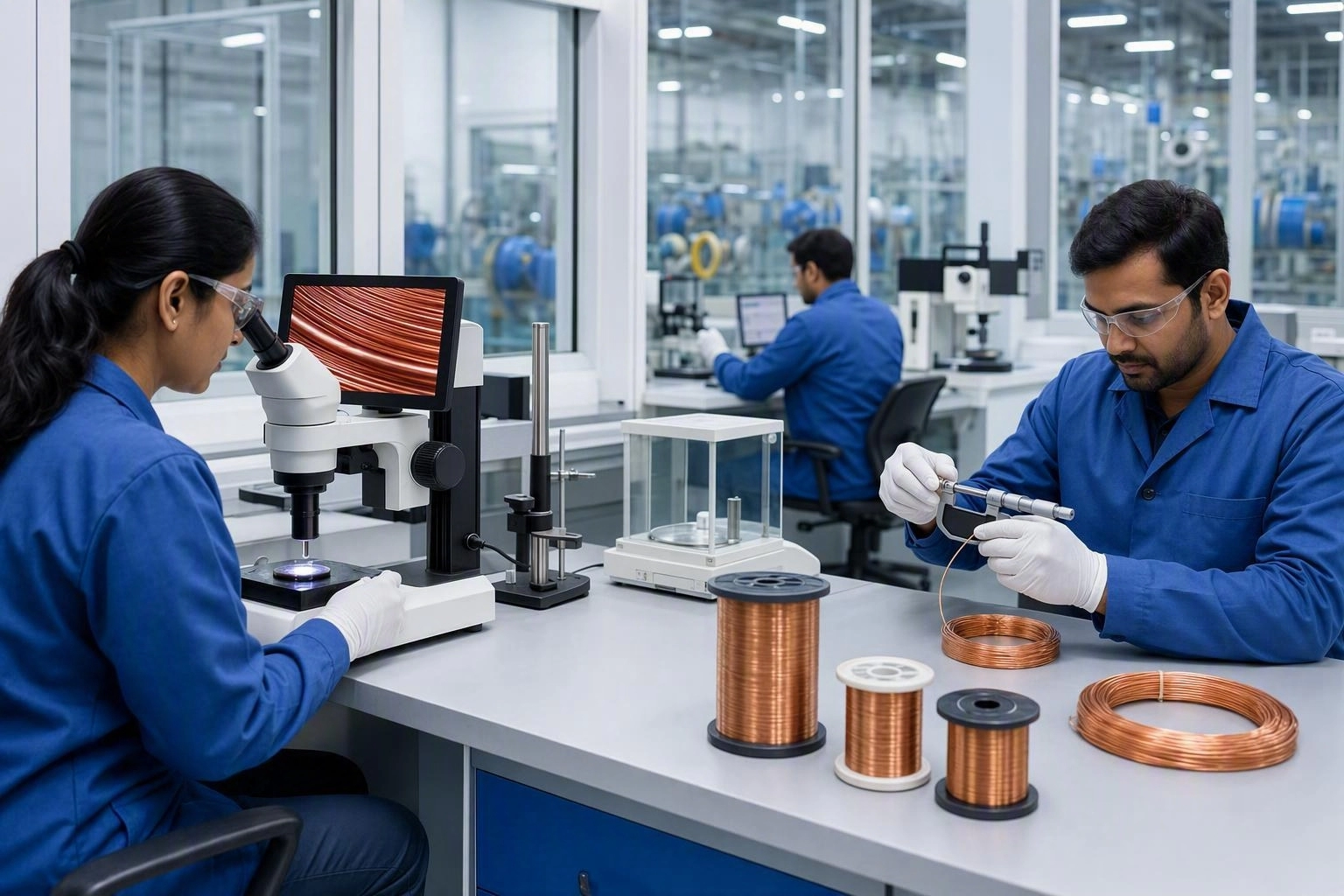
What standards do not do is guarantee batch to batch consistency, or prove that a particular production lot was actually made within specification. A standards claim describes the design intent; independent measurements describe what was delivered. Effective procurement uses both.
The Two Main Standards Families
| Standard | Origin | Coverage |
|---|---|---|
| IEC 60317 series | International Electrotechnical Commission | Specifications for particular types of winding wire, with parts covering each enamel class |
| NEMA MW 1000 | US National Electrical Manufacturers Association | Comprehensive magnet wire standard covering many grades and test methods |
| GB/T series | China national standards | Domestic equivalents and supplements, widely referenced in Chinese production |
| JIS series | Japanese Industrial Standards | Japanese specifications, common in Asian supply chains |
The IEC 60317 series is organised by wire type, with individual parts addressing specific enamel chemistries, conductor shapes and temperature classes. NEMA MW 1000 takes a broader approach, defining grades and providing detailed test procedures. In practice, international projects frequently reference IEC for electrical properties and a national standard for dimensional and mechanical characteristics.
The Tests That Actually Predict Performance
Dimensional
- Conductor diameter — sets resistance and must be measured on bare wire.
- Overall diameter — sets whether the wire fits the winding design.
- Concentricity — determines whether dielectric strength is uniform around the circumference.
Mechanical
- Elongation and tensile strength — predict whether the wire survives winding.
- Flexibility and adherence — confirm that the coating withstands bending and stretching without cracking or detaching.
- Scrape resistance — indicates abrasion performance during automated winding.
- Adhesion after ageing — shows whether the coating remains attached after thermal exposure.
Electrical
- Dielectric breakdown voltage — measured on twisted pairs or straight specimens as the standard requires.
- Continuity and pinhole count — indicates coating defects along the length.
- Insulation resistance — relevant for high impedance and sensor windings.
- Partial discharge inception voltage — increasingly required for inverter duty grades.
Thermal and Chemical
- Thermal class verification by accelerated ageing.
- Solderability for grades intended for solder termination, including after ageing.
- Resistance to solvents and refrigerants for hermetic and chemically exposed applications.
Environmental and Regulatory Compliance
Beyond product standards, magnet wire is subject to environmental regulation that affects material selection. The EU Restriction of Hazardous Substances directive restricts substances including lead, mercury, cadmium and certain brominated flame retardants. REACH addresses chemical substances more broadly, including reporting obligations. Buyers in Europe and in markets that follow European practice should request documentation confirming compliance for each shipment, not a general statement covering all products.
Compliance documentation should identify the specific wire grade and production reference. A certificate that lists no grade is of limited value in a traceability investigation.
What to Check Beyond the Certificate
- Sampling frequency — how often are measurements taken, and on what sample size?
- In process control — are diameter and enamel viscosity monitored continuously or checked at intervals?
- Traceability — can a delivered spool be traced to a production lot and its test record?
- Trend data — do measurements sit in the middle of the tolerance band or near the edges? A supplier consistently at the limit is not truly in control.
- Change notification — how will you be told if a raw material supplier or process changes?
- Complaint handling — what is the defined response time and investigation process?
Establishing a Working Relationship
The most reliable supply relationships include an agreed incoming inspection protocol. Rather than testing everything, buyer and supplier agree which parameters are checked at goods receipt, which are covered by the supplier's certificate, and what the escalation path is when a result is out of tolerance. This avoids both the cost of exhaustive incoming inspection and the risk of relying entirely on supplier data.
For new programmes, an initial qualification batch with full characterisation is worth the investment. It establishes a baseline against which later shipments can be compared, and it surfaces issues such as coating concentricity or solderability after ageing before volume production begins.
How Huaya Fa Supports Compliance
Huaya Fa operates ISO 9001 quality management and ISO 14001 environmental management systems across two manufacturing bases, with approximately 3,000 tonnes monthly capacity. Enameled wire is produced to class 130 through class 240 in copper, aluminium and copper-clad aluminium, round from 0.03 mm to 3.50 mm and in rectangular profiles.
Shipments are accompanied by material compliance documentation for RoHS and REACH, and test records for the parameters relevant to the specified grade. Where a customer requires additional testing to a particular standard or an agreed sampling plan, this can be arranged as part of the supply agreement.
Common buyer questions
Is IEC compliance the same as NEMA compliance? No. The standards overlap in intent but differ in detail, including test conditions and acceptance criteria. Specify which standard applies to your programme.
Can a supplier claim a thermal class without testing? The class should be supported by test data. Ask for the underlying report.
How often should incoming inspection be performed? At least for the first few shipments of a new grade, and thereafter on a reduced sampling plan once consistency is demonstrated.


