
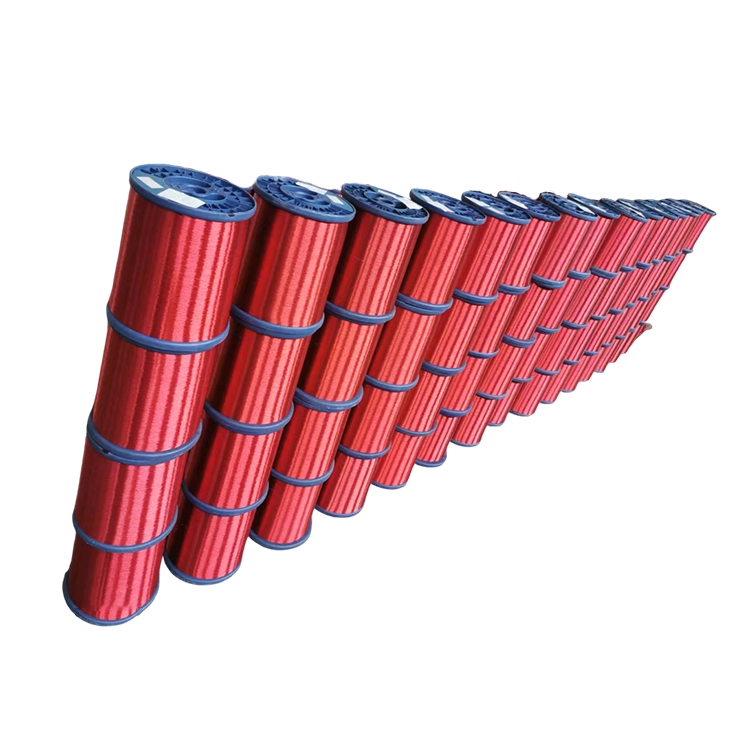
Selling magnet wire under your own brand is one of the fastest ways for a distributor or motor manufacturer to move up the value chain. Instead of competing on the spot price of a commodity, you control the specification, the packaging and the technical support that surrounds it.
But private label enameled wire is not simply "our label on their spool". It is a production discipline that starts with a frozen specification and ends with a documentation pack that your customers can audit. This guide walks through the decisions that determine whether a private label programme ships on time and stays consistent batch after batch.
What Private Label Actually Changes
The wire itself may be identical to a standard catalogue item. What changes is everything that touches the customer:
- Identity — your brand, part number and technical data sheet replace the manufacturer's.
- Specification custody — you own the controlling drawing, and every shipment is measured against it.
- Packaging — spool colour, label layout, carton printing and pallet configuration become your assets.
- Documentation — certificates, test reports and declarations are issued under your name.
Because the customer relationship is yours, the risk profile changes too. A dimensional drift or an insulation-grade substitution is no longer the supplier's problem alone — it lands on your brand. That is why the specification lock below matters more than the print on the label.
Step 1: Freeze the Specification Before You Print Anything
Every private label programme should begin with a single controlling document. If the specification is still moving while artwork is being designed, you will reprint labels and re-issue data sheets — often twice.
The controlling specification should fix, at minimum:
| Parameter | What to lock | Typical range |
|---|---|---|
| Conductor | Copper, aluminium or CCA | Cu / Al / CCA |
| Nominal diameter | Single value plus tolerance band | 0.05 – 6.00 mm |
| Thermal class | The class you will warrant | 130 / 155 / 180 / 200 / 220 / 240 °C |
| Insulation build | Grade 1, 2 or 3 | Grade 2 most common |
| Colour | Natural, red, blue, green, black | Natural unless specified |
| Spool type | Material, flange diameter, bore | Plastic / wooden, ISO or custom |
| Net weight | Nominal and tolerance | 0.5 – 30 kg per spool |
Two disciplines keep this stable. First, version the document and reference the version on every purchase order. Second, treat any change — even a colour tweak — as a revision that requires your written approval. Informal changes agreed over chat are the single most common cause of a batch that does not match the sample your customer approved.
Step 2: Decide Where Your Brand Appears
There are four surfaces available, and each has a different cost and lead time.
| Surface | Typical method | Lead time impact | Notes |
|---|---|---|---|
| Spool flange label | Custom printed label | Low — reorder only | Cheapest place to start |
| Spool body | Moulded or printed flange | High — tooling required | Only justified at volume |
| Carton | Flexo or digital print | Medium | Watch minimum print runs |
| Pallet / drum | Stencil or printed label | Low | Often overlooked, high visibility |
For a first private label launch, most suppliers advise starting with a custom flange label and a printed carton. Both can be revised with low tooling exposure, and together they cover the surfaces a customer actually sees when the goods arrive. Moulded spools should wait until volumes justify the tooling, which typically means several containers per year on a single size.
Step 3: Control the Artwork File
Artwork is where small errors become expensive. Three items cause most of the reprints we see:
- Colour mode and stock — a label designed in RGB for a screen will shift when printed on white polypropylene. Specify the stock and supply artwork in the correct profile.
- Minimum type size — spool labels are read at arm's length in a warehouse. Keep the part number and net weight legible at 8 pt or larger.
- Barcode encoding — confirm whether your customer expects a GTIN, an internal code, or both, and verify the symbology with a scan test before mass printing.
Ask for a physical proof, not a PDF. A printed proof on the actual label stock is the only way to confirm that the contrast and the barcode scan behave as expected.
Step 4: Build the Documentation Set
Private label buyers are audited by their own customers, so the documentation pack is part of the product. A complete set for a magnet wire programme normally includes:
- Technical data sheet on your letterhead, matching the controlling specification version.
- Certificate of Conformance for each shipment, referencing the PO and the batch.
- Routine test report — conductor diameter, insulation thickness, elongation, breakdown voltage, adhesion.
- Material declarations: RoHS, REACH and, where relevant, a conflict-minerals statement.
- Quality system certificate — ISO 9001 for the manufacturing site, plus ISO 14001 if environmental performance is part of your pitch.
The manufacturer supplies the underlying data; you re-issue it under your brand. Keep the traceability link between your document number and the factory batch number so a field failure can be investigated without guesswork.
Step 5: Qualify the First Production Batch
Never let the first private label shipment go straight to a customer's line. Run a first-article qualification:
- Measure a statistically meaningful sample of spools against every dimension in the controlling specification.
- Witness the routine electrical tests — breakdown voltage and adhesion are the two that most often reveal a process drift.
- Wind a trial coil on the customer's equipment, or on equipment with an equivalent tension and speed profile.
- Compare the insulation colour and surface finish against the approved golden sample under the same lighting used at goods-in.
Document the result and keep the golden sample. When a dispute arises twelve months later, the golden sample and the signed first-article report settle it in minutes.
Planning a private label range? Send us your controlling specification and target spool configuration. We supply custom enameled and magnet wire under OEM and ODM programmes — conductor material, diameter, thermal class, colour and packaging all built to your drawing, with ISO 9001 and RoHS documentation issued in your name.