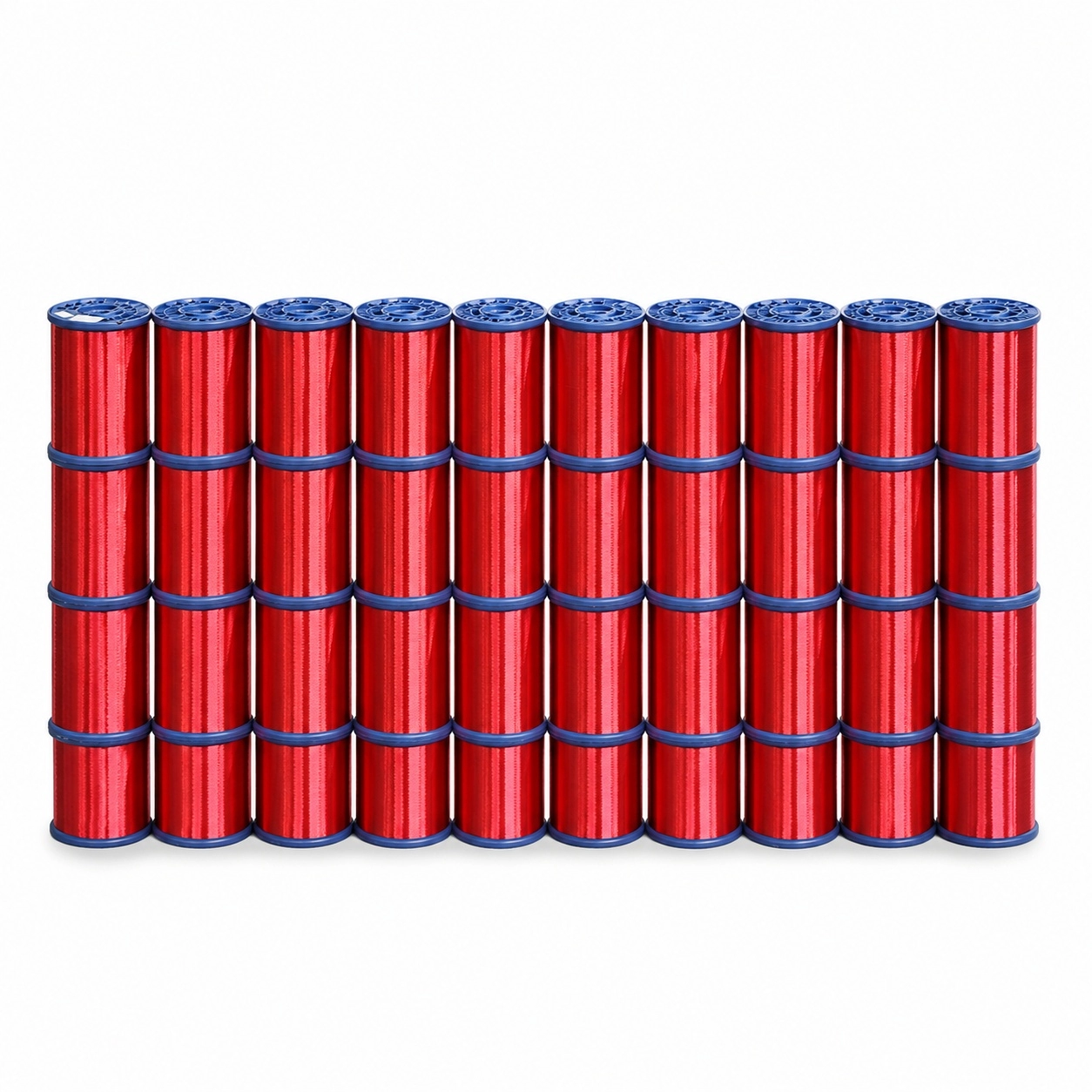
What Self-Bonding Wire Is
A self-bonding enameled wire, sometimes called a bondable or self-adhesive wire, carries an additional outer layer on top of the normal enamel insulation. This outer layer is thermoplastic: it is solid at operating temperature but softens and flows when the wound coil is heated above a defined activation temperature. On cooling, adjacent turns are bonded into a single rigid unit.
The underlying electrical insulation is unchanged. The bonding layer is applied over the functional enamel and does not replace it, so dielectric performance is determined by the base insulation system exactly as with conventional wire.
Why Manufacturers Use It
- Eliminates or reduces varnish impregnation, removing a process step, its curing time and its associated equipment.
- Improves mechanical rigidity, which reduces movement and abrasion in vibrating applications.
- Stabilises inductance, because turns cannot shift relative to each other after bonding.
- Enables cleaner assembly, since there is no varnish to contaminate adjacent components or require masking.
- Supports compact designs, where a self-supporting coil can replace a bobbin in some constructions.
For high volume appliance and small motor production, the elimination of a curing oven is often the main economic driver. For precision instruments, the improvement in dimensional stability is the primary benefit.
How the Bonding Process Works
| Stage | What happens | Practical considerations |
|---|---|---|
| Winding | Wire is wound normally; the bonding layer is inert | Standard winding equipment can be used with attention to tension |
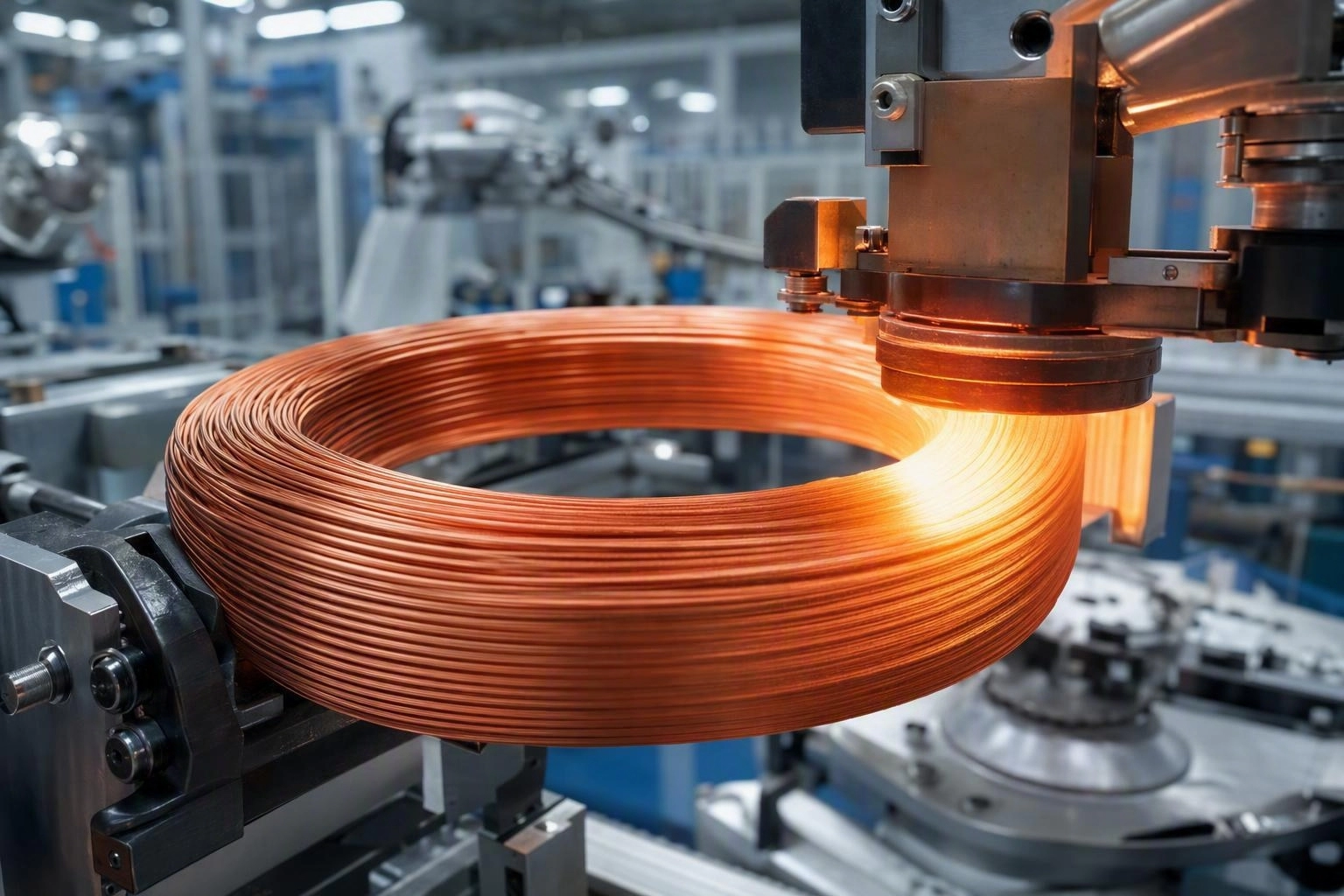
| Activation | Coil is heated above the bonding layer softening point | Oven, hot air, or resistance heating through the winding itself |
| Soak | Bonding layer flows and wets adjacent turns | Temperature uniformity across the coil is critical |
| Cooling | Bonding layer solidifies, locking turns in place | Cooling rate affects final bond strength |
The activation temperature is selected to sit comfortably above the maximum operating temperature of the machine but below the thermal limit of the base enamel. Getting this window right is the central process engineering task.
Process Control Points
- Activation temperature must be measured at the winding, not at the oven set point, because large coils heat unevenly.
- Soak time must be long enough for the bonding layer to flow throughout the coil, including the inner layers where heat arrives last.
- Winding tension affects bond quality: turns that are not in contact cannot bond to each other.
- Cooling profile influences final mechanical strength and should be defined rather than left to ambient conditions.
- Base enamel class must exceed the activation temperature with adequate margin.
Grades and Combinations Available
Self-bonding layers are applied over several base insulation systems, which allows thermal class and bonding behaviour to be selected independently:
- Polyurethane base, class 130–180 — solderable, economical, widely used in small motors and coils.
- Polyester base, class 155–180 — good general purpose performance.
- Polyester-imide base, class 180–200 — higher thermal margin for hotter machines.
- Polyamide-imide base, class 200 and above — for demanding duty where bonding is also required.
Solderable self-bonding grades are particularly convenient in small coil production, because the same wire can be bonded and then soldered without stripping. Where solderability after bonding is required, it should be confirmed by test, since the heat of the bonding cycle also ages the enamel.
Where Self-Bonding Wire Is Not the Answer
The technique has limits that are worth stating plainly. Bonding strength is lower than a well-executed vacuum impregnation, so applications with severe vibration or large electromagnetic forces may still require varnish. Bonding is also sensitive to coil geometry: very large coils are difficult to heat uniformly, and very densely wound coils may not allow the bonding layer to reach the inner turns.
In these cases a hybrid approach is common: self-bonding wire to hold the winding during handling, followed by a lighter impregnation cycle for environmental protection. This captures most of the assembly benefit while retaining full varnish performance.
Selection Guidance
- Confirm the maximum operating temperature of the machine, then select a base class above it with margin.
- Determine the required activation temperature and verify that the production oven can achieve it uniformly.
- Decide whether solderability is required, and if so after what thermal exposure.
- Check bond strength requirement against the mechanical loads the coil will see.
- Validate the complete cycle on real coils before committing to volume production.
Availability
Huaya Fa supplies self-bonding enameled copper round wire with polyurethane and polyester base insulation across class 130 to class 200, including solderable grades, in diameters from 0.03 mm to 3.50 mm. Standard self-bonding wire is also offered in combination with high thermal class systems for applications requiring both bonding and heat resistance.