
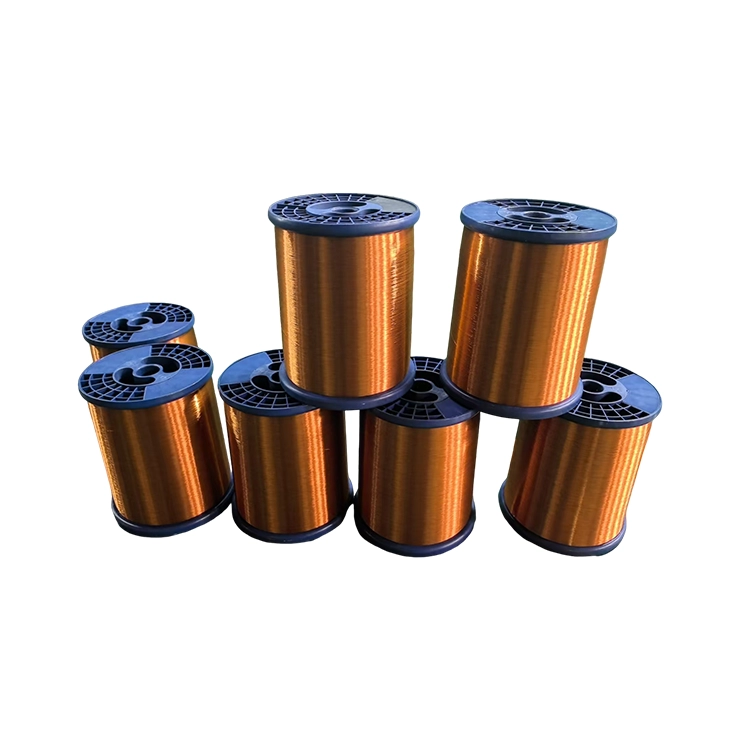
Most magnet wire complaints are not about the wire. They are about how it arrived — a crushed spool, a label that does not match the purchase order, a layer of surface corrosion after six weeks at sea, or a net weight that is short by more than the tolerance allows.
Packaging is cheap to specify correctly at the quotation stage and expensive to correct after a container has been loaded. This checklist is written from the goods-in perspective: it covers what the receiving inspector will measure, and what your supplier needs to know before production starts.
1. Spool Specification
The spool is the primary handling interface. Specify it explicitly rather than accepting "standard export packing".
| Attribute | Why it matters | Typical options |
|---|---|---|
| Material | Strength, moisture behaviour, recyclability | ABS plastic, PS, plywood, hardboard |
| Flange diameter | Must clear your winding machine and your racking | 125 / 160 / 200 / 250 / 315 mm |
| Traverse / barrel width | Controls the coil build and pay-off behaviour | 90 – 400 mm |
| Bore diameter | Nozzle or spindle fit | 16 / 20 / 25 / 50 mm |
| Returnable vs single-use | Freight economics and reverse logistics | Single-use most common for export |
If the spools feed a machine with a fixed spindle, send the supplier a drawing with the bore diameter and the maximum flange diameter annotated. A 10 mm discrepancy is enough to make a shipment unusable at the customer line even though the wire is perfect.
2. Net Weight and Tolerance
State net weight per spool and the acceptable tolerance band in writing. Common practice is a nominal figure with a minus tolerance that protects the customer and a plus tolerance that protects the supplier from over-filling and spool over-stress.
- Confirm whether the quoted price is per kilogram of net wire or per spool.
- Decide whether the spool tare weight is included in the gross figure on the packing list.
- Agree the weighing method — calibrated floor scale, and whether the sample is 100% or by lot.
- For high-value fine wire, expect 100% weighing rather than statistical sampling.
Under-filling is the more common failure. It is also the more damaging, because it silently raises the customer's cost per metre and is hard to detect after the spool is on the machine.
3. Moisture and Corrosion Protection
Enameled wire is not immune to atmospheric attack, particularly aluminium and copper-clad aluminium conductors. Sea freight in a container that cycles through condensation is the classic failure scenario.
| Measure | When to specify | Notes |
|---|---|---|
| Stretch or shrink wrap per spool | Always | Cheapest single protection |
| Desiccant sachet | Aluminium and CCA, humid routes | Place inside the barrier, not outside |
| VCI film | Long transit, bare copper ends | Vapour-phase corrosion inhibitor |
| Moisture barrier liner | Container shipment, > 6 weeks | Must be sealed, not just draped |
| Container desiccant | Full container loads | Sized to transit days and container type |
If the conductor ends are exposed — for example where a spool has an outer tail for pay-off — specify that the tail is secured under the wrap rather than left exposed.
4. Carton and Pallet
The carton carries the compression load, and the pallet determines whether it survives handling. Specify both:
- Carton grade — give a board grade or a burst strength figure, not just "export quality".
- Compression strength — ask for the stacking height and the storage duration the carton is rated for.
- Inner fitment — foam or board inserts stop spools from shifting and abrading each other.
- Pallet type — heat-treated wood for ISPM 15 countries, or plastic / presswood alternatives.
- Pallet pattern — the number of cartons per layer, layers per pallet, and whether the load will be floor-stacked or racked.
- Unitisation — stretch film alone, or strapping plus corner boards for heavy loads.
Take a photograph of the agreed pattern and attach it to the PO. A picture removes more ambiguity than a paragraph of description.
5. The Label Data Set
A goods-in inspector will match the label against the purchase order. Every field below should be present, and the format should be fixed so it can be scanned and keyed without interpretation:
| Field | Purpose |
|---|---|
| Your part number | Primary match to PO line |
| Manufacturer batch / lot code | Traceability in a field failure |
| Conductor material | Prevents mixing Cu / Al / CCA stock |
| Nominal diameter | Primary dimensional check |
| Thermal class and insulation type | Prevents wrong-grade issue |
| Colour | Visual verification |
| Net weight and gross weight | Quantity reconciliation |
| Spool tare weight | Enables net calculation if re-weighed |
| Production date | Shelf-life and FIFO control |
| Country of origin | Customs and trade compliance |
| Barcode / GTIN | System entry |
| Handling symbols | ISO 780 pictograms |
6. Pre-Shipment Verification
Before the container is sealed, request a documented pre-shipment inspection covering:
- Label accuracy — all twelve fields above, photographed on a sample of spools.
- Net weight verification — with the scale reading visible in the photograph.
- Spool condition — flange integrity, no crush damage, no contamination.
- Carton drop and stack test result, or a photographic record of the stack pattern.
- Photographs of the sealed pallet and the loaded container, including the door-end blocking.
This is a fifteen-minute exercise for the supplier and it eliminates the majority of goods-in disputes. Make it a contractual condition rather than an optional extra.
Need custom packaging built to your receiving standards? We supply OEM and ODM enameled and magnet wire with customer-specified spool type, net weight, moisture protection, carton and pallet configuration, and a label layout that matches your part numbering. Send us your packing specification and we will confirm feasibility before quoting.