
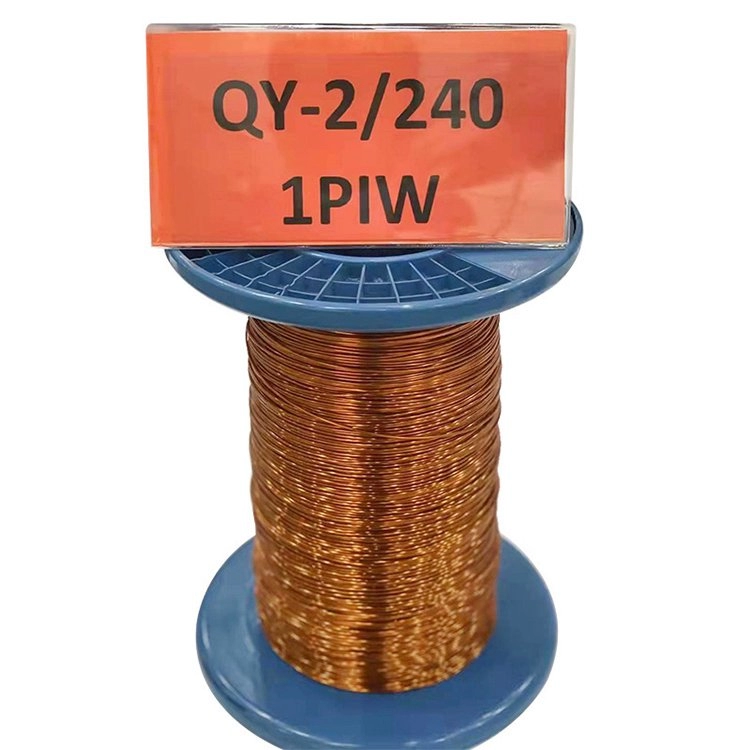
We have brought additional polyamide-imide — AIW, 220 °C — enamelling capacity online. The new line is dedicated to high-temperature builds and is aimed squarely at the demand growth we are seeing from inverter-duty motors, EV traction and high-efficiency compressor applications.
This note sets out what changed, which specifications benefit, and what buyers of high-temperature magnet wire should expect as a result.
What Has Changed
| Item | Before | Now |
|---|---|---|
| Temperature range covered | 130 – 200 °C | 130 – 240 °C |
| AIW 220 °C availability | Limited, scheduled around other grades | Dedicated line capacity |
| Diameter range on the new line | — | 0.10 – 3.00 mm |
| Sample lead time, AIW | Extended | Materially shorter |
| Production lead time, AIW | Congested behind standard grades | Scheduled directly |
The important change is not only volume. Because the line is dedicated to high-temperature builds, AIW orders no longer queue behind standard 130 – 180 °C production. That removes the least predictable element from the schedule for buyers of high-temperature wire.
Why 220 °C Demand Is Growing
Polyamide-imide over polyester or polyester-imide base coats — the AIW construction — is the established answer when a winding must survive higher continuous temperatures or short-term thermal excursions. Three application trends are driving volume:
- Inverter duty. Variable-frequency drives expose windings to fast voltage transitions and elevated local heating. Higher thermal-class insulation gives the design margin needed to keep a class B or F rating in practice.
- EV and hybrid traction. Traction motors run hot, and the push toward higher power density and higher DC bus voltages leaves less thermal headroom everywhere in the winding.
- High-efficiency compressors and industrial motors. Efficiency regulations have pushed designers toward more copper, tighter magnetic circuits and hotter running points — all of which raise the winding temperature for a given frame size.
The other driver is corona resistance. Where the application combines high temperature with inverter waveforms, a high-temperature build is often specified together with a corona-resistant construction. We supply both, and can advise on which the application actually needs.
Specifications Covered
The expanded capacity covers the following high-temperature constructions:
| Construction | Thermal class | Typical application |
|---|---|---|
| AIW — polyamide-imide over polyurethane | 220 °C | Motors, transformers, inverter duty |
| PEI/PAI — polyester-imide over polyamide-imide | 200 / 240 °C | Traction motors, severe-duty windings |
| EI/AIW — composite, bond coat option | 200 / 220 °C | Hermetic motors, transformers |
| Corona-resistant grades | 200 – 240 °C | Inverter-fed motors, HV drives |
Conductor options on the new line are copper and copper-clad aluminium, in round section. Aluminium is available on the standard lines for applications where weight or cost dominates.
What This Means for Lead Times
Buyers of high-temperature wire should see improvement in two places:
- Sample response — a sample of a standard AIW specification can be scheduled without waiting for a gap in another grade's production.
- Production scheduling — AIW orders are planned on dedicated capacity, so the delivery date no longer depends on how congested the standard-grade lines are in a given month.
As always, the lead time quoted on a specific order still depends on the conductor diameter, the colour, the enamel build and the volume. A non-standard diameter or a special colour will extend the schedule regardless of line availability, because those introduce a separate setup.
Quality Controls on the New Line
The new capacity operates under the same quality system and test regime as our existing lines:
- Incoming conductor inspection — diameter, surface condition, conductivity.
- In-process monitoring of enamel build, oven temperature profile and line speed.
- Routine finished-wire testing — conductor diameter, insulation thickness, elongation, breakdown voltage, adhesion, and flexibility by mandrel and elongation.
- Thermal class verification by the applicable IEC 60317 / NEMA MW 1000 method.
- Certification to ISO 9001 and ISO 14001, with RoHS and REACH declarations issued per shipment.
Test reports reference the production batch, so a high-temperature specification ordered today is traceable in the same way as a standard build ordered last year.
Need AIW 220 °C or another high-temperature build? Send us the conductor, diameter, thermal class and application conditions — including inverter waveform details if relevant — and we will confirm the correct construction, the sample route and a scheduling date on the new capacity.