What a Thermal Class Number Really Means
A thermal class is not a maximum operating temperature in the sense of a fuse rating. It is a classification based on accelerated ageing tests, indicating the temperature at which the insulation system is expected to provide a defined service life under controlled conditions — conventionally around 20,000 hours at the class temperature in the standard test regime.
Two points follow from this definition. First, operating below the class temperature extends life, and operating above it shortens life rapidly. Second, the class rating applies to the insulation system as a whole, not to a single enamel layer in isolation.
The Standard Classes
| Class | Temperature | Typical insulation chemistry | Common applications |
|---|---|---|---|
| 130 | 130 °C | Polyvinyl acetal, basic polyurethane | Small transformers, low duty coils |
| 155 | 155 °C | Polyurethane, polyester, solderable grades | General motors, fans, pumps, appliances |
| 180 | 180 °C | Polyester-imide, modified polyurethane | Industrial motors, transformers, drives |
| 200 | 200 °C | Polyester-imide composite, polyamide-imide base | Automotive, high load industrial machines |
| 220 | 220 °C | Polyamide-imide composite | Traction, hermetic compressors, heavy duty drives |
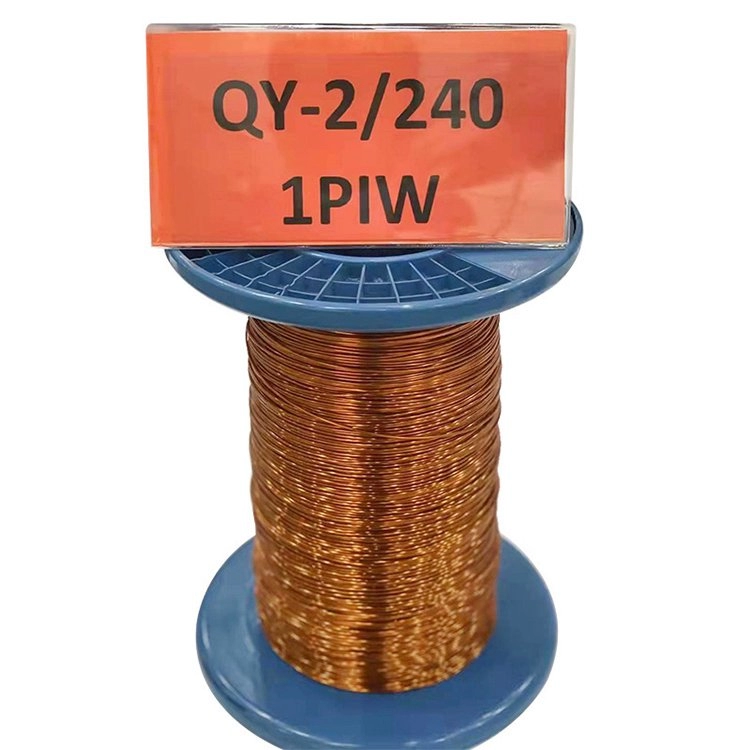
| 240 | 240 °C | Polyimide and polyamide-imide composites | Aerospace, extreme duty, high reliability systems |
How Thermal Class Is Verified
Thermal class is established by accelerated ageing, in which specimens are held at elevated temperature and their properties are measured periodically until they fall below defined limits. The results are extrapolated to estimate the temperature at which the target life would be achieved. Different standards use different failure criteria and different extrapolation methods, so a class claim should always be read together with the method behind it.
The properties commonly monitored include dielectric strength, flexibility, adhesion and, for solderable grades, the ability to be soldered after ageing. A wire may retain dielectric strength while losing flexibility, which matters in a winding that must tolerate vibration.
Choosing the Right Class
Selection is driven by the calculated hot spot temperature plus margin. The calculation should account for:
- Ambient temperature at the installation, including enclosure effects.
- Load profile, including sustained overloads and duty cycles that produce repeated thermal excursions.
- Cooling method, since a sealed enclosure eliminates the convection path that a design may assume.
- Altitude and airflow, which affect heat removal capability.
- Service life expectation, because a machine intended to run for twenty years needs more margin than one designed for five.
A widely used rule of thumb is that insulation life approximately halves for every 10 °C increase in operating temperature above the class rating. This is why operating margin is worth paying for: a modest reduction in hot spot temperature can multiply expected life.
Common Misunderstandings
Higher class always means better wire
Not necessarily. A class 240 polyimide wire may have lower flexibility or different handling characteristics than a class 155 polyurethane wire. The correct grade is the one that matches the application. Using an unnecessarily high class increases cost without improving reliability where the thermal environment is mild.
The class rating covers the whole winding
In practice it covers the insulation system. Impregnating varnish, slot liner, phase insulation and lead wire all contribute. A high class enamel combined with a low class varnish will fail at the varnish temperature.
The temperature limit is a sharp boundary
Degradation is continuous rather than abrupt. Running slightly above the class temperature does not cause immediate failure, but it does consume life at an accelerating rate. Short term overloads are therefore best evaluated on a cumulative life consumption basis rather than a simple pass or fail check.
Solderability is independent of class
It is not. Solderable grades are convenient because they eliminate the stripping step, but solderability degrades with thermal ageing. Where a winding must remain solderable after exposure to high temperature, this should be specified and tested explicitly.
Specification Checklist
- State the required thermal class together with the assumed ambient temperature and cooling method.
- Ask for the test standard used to establish the class.
- Require adhesion after ageing data, not only initial adhesion.
- Confirm that the impregnation system matches or exceeds the enamel class.
- For solderable grades, specify the post-ageing solderability requirement.
- Verify that the grade is available in the required conductor type and diameter.
Supply Range
Huaya Fa manufactures enameled wire across the full thermal range from class 130 to class 240, covering polyurethane, polyester, polyester-imide, polyamide-imide and polyimide systems, in copper, aluminium and copper-clad aluminium conductors and in both round and rectangular profiles. Round wire spans 0.03 mm to 3.50 mm. Manufacturing is certified to ISO 9001 and ISO 14001 and complies with RoHS and REACH.