
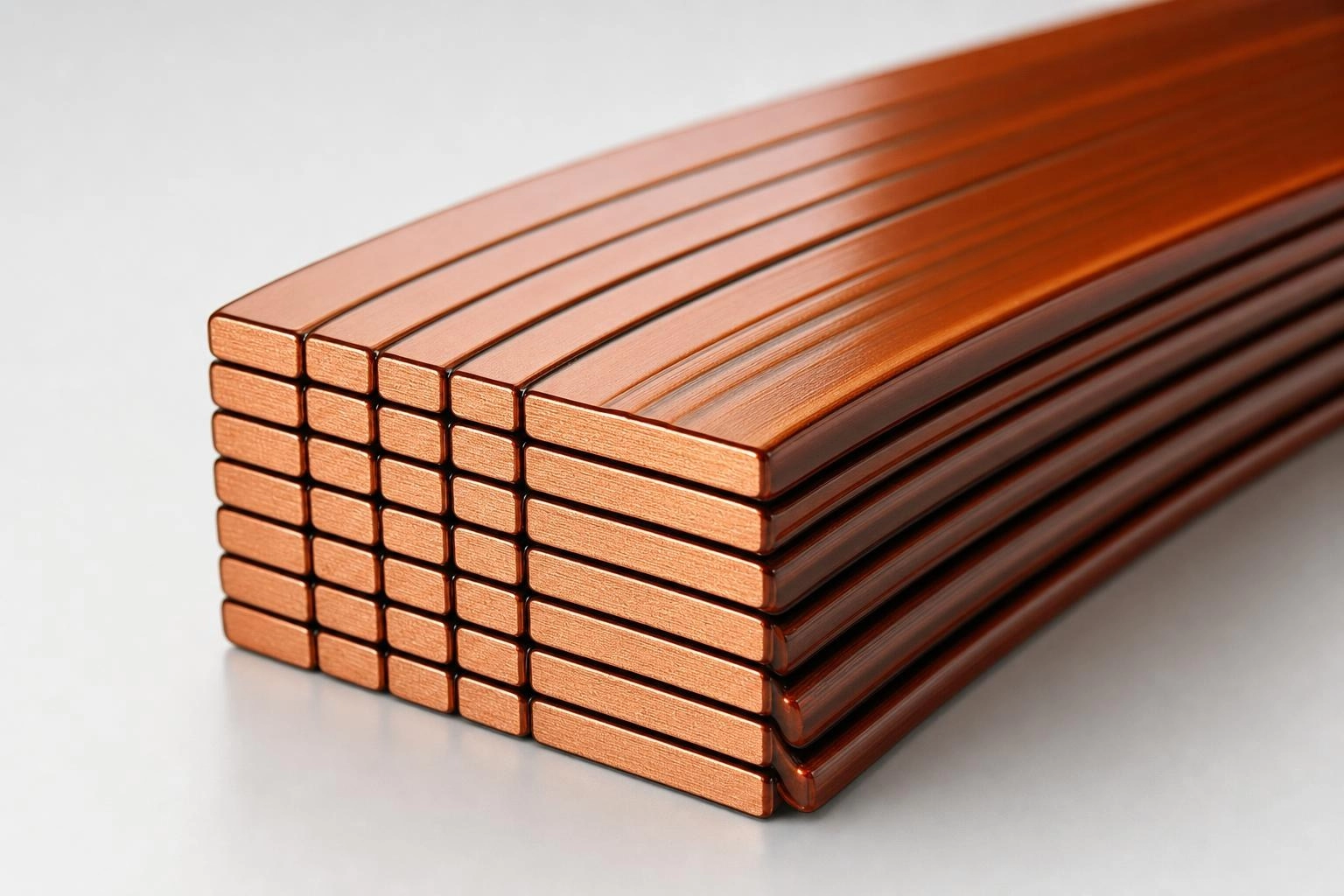
The Slot Fill Problem
In a conventional stator, round wire is wound into slots that are not round. Circles cannot tile a rectangular cross-section efficiently, so a significant fraction of each slot is occupied by voids and by the space needed for insulation. Typical round wire fill factors leave a substantial part of the slot unused.
Rectangular enameled wire changes this by matching the conductor shape to the slot shape. Flat conductors can be stacked in layers that fill the available cross-section much more completely, so more copper occupies the same volume.
Why More Copper in the Same Space Matters
- Higher efficiency — lower resistance for the same current reduces I²R losses directly.
- Better thermal performance — more copper and less air means better heat conduction from the winding to the stator core.
- Higher power density — a smaller machine can deliver the same output, or the same machine can deliver more.
- Improved overload capability — thermal headroom extends permissible short term loading.
These advantages explain why rectangular wire has become standard practice in high performance traction motors, in high efficiency industrial machines and in applications where envelope size is constrained.
Conductor Geometry Decisions
| Parameter | Consideration |
|---|---|
| Width to thickness ratio | Higher ratios fill slots better but reduce bending flexibility and raise forming stress |
| Corner radius | Sharp corners concentrate electrical and mechanical stress; a defined radius is essential |
| Thickness tolerance | Determines how consistently layers stack and how predictable the fill factor is |
| Width tolerance | Affects side by side placement and insulation clearance to the slot wall |
| Enamel build | Adds to overall dimensions and must be included in the fill calculation |
| Conductor material | Copper for maximum conductivity; aluminium and CCA for weight and cost reduction |
The fill factor calculation must use the overall dimensions including enamel, not the bare conductor dimensions. This is a common source of design error, because the enamel build on a flat conductor is proportionally more significant than on a large round conductor.
Corner Radius and Insulation Integrity
The corners of a rectangular conductor are the weak point of the insulation system. When the wire is bent to form a hairpin or a coil segment, the enamel on the outside of the bend is stretched, and the stress concentrates at the corner. If the corner radius is too small, the coating can crack or thin below the required dielectric level.
Good practice is to define a minimum corner radius, to verify coating coverage at the corner after forming, and to test dielectric strength on formed specimens rather than on straight samples only. This is one of the areas where rectangular wire requires more supplier and customer collaboration than round wire.
Manufacturing Demands of Flat Conductor Windings
- Forming — precise bending without damaging the coating, often with controlled springback compensation.
- Insertion — placing rigid conductors into slots without scratching the enamel against the slot liner.
- Welding or brazing — joining hairpin ends reliably, which requires clean stripping and controlled heat.
- Insulation coordination — ensuring phase insulation and slot liners are compatible with the tighter clearances of a high fill winding.
These steps are more demanding than round wire winding, and they explain why rectangular wire tends to be adopted where the performance benefit justifies the investment in tooling and process development.
Materials and Insulation Options
Rectangular enameled wire is produced in copper, aluminium and copper-clad aluminium. Copper remains the choice for maximum efficiency. Aluminium and CCA are selected where weight reduction or cost saving matters more than conductivity, and where the larger cross-section required can be accommodated in the slot.
Insulation systems for flat wire mirror those for round wire: polyurethane and polyester for general purpose duty, polyester-imide for higher temperature, and polyamide-imide based composites for class 200 and above, including corona resistant variants for inverter duty machines.
Selection Checklist
- Define slot dimensions precisely, including liner thickness and tolerances.
- Specify conductor width, thickness and corner radius with realistic tolerances.
- Calculate slot fill using overall dimensions including enamel build.
- Confirm the maximum bend radius required by the forming process.
- Require dielectric testing on formed specimens, not only on straight lengths.
- Agree the stripping and joining method with the wire supplier, since these affect termination reliability.
Supply Range
Huaya Fa produces rectangular enameled wire in copper, aluminium and copper-clad aluminium, with insulation grades from class 130 to class 240, alongside a round wire range from 0.03 mm to 3.50 mm. Two manufacturing bases and approximately 3,000 tonnes monthly capacity support both development quantities and volume programmes, with ISO 9001 and ISO 14001 certification and RoHS and REACH compliance.


