
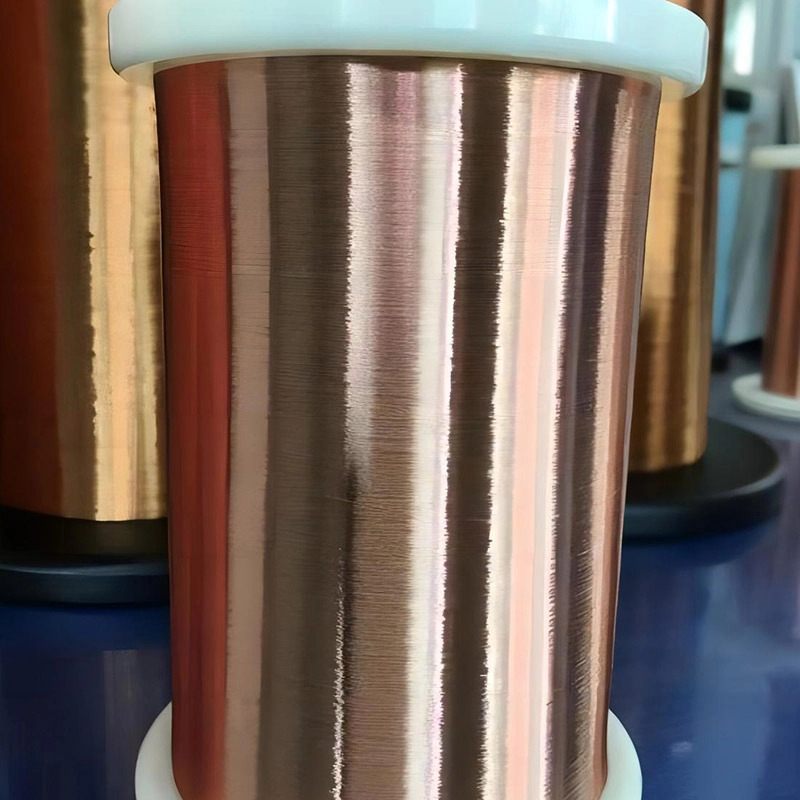
When a buyer asks for a custom magnet wire specification, the three numbers that decide whether the project is viable are the minimum order quantity, the tooling investment and the lead time. Suppliers often quote these as fixed constraints. In practice all three are driven by identifiable production factors, and a buyer who understands the drivers can restructure an order to reduce each one.
This article separates the genuine physical constraints from the commercial ones, so that negotiations focus on the things that can actually be changed.
What Actually Drives MOQ
Minimum order quantity is not an arbitrary threshold. It is the point at which the setup cost per kilogram becomes acceptable. Four factors set it:
| Driver | Effect on MOQ | How to relax it |
|---|---|---|
| Drawing and enamelling line setup | Dominant for a new diameter | Accept the standard diameter nearest your target |
| Enamel batch size | Dominant for an unusual colour or resin | Use a standard colour, or share a batch with a sister part |
| Conductor sourcing | Rises for non-standard alloys or fine gauges | Choose a catalogue conductor size |
| Packaging tooling | Adds a one-off component, not a per-kg floor | Start with a printed label only |
The practical consequence: MOQ is driven much more by the conductor diameter and enamel colour combination than by the total tonnage. Two orders that look similar in weight can have very different minimums if one uses a stock diameter in a natural colour and the other uses a special gauge in a custom tint.
If your annual volume is genuinely below the quoted minimum, the standard approach is to place one larger order and schedule releases against it, rather than to push for a lower minimum. The supplier gets an efficient production run; you get the annual quantity at a better unit price and avoid repeated setup charges.
Tooling: What You Are Really Paying For
Tooling charges on a magnet wire order fall into four distinct buckets. Ask for them separately, because they behave very differently.
- Drawing dies — specific to the finished conductor size. Usually a modest, recurring item; often shared across several similar diameters.
- Enamelling applicator or die set — specific to the enamel build and the number of passes. The most common genuine tooling charge.
- Spool mould — a large one-off, justified only at sustained volume on a single spool size.
- Print tooling — plates or cylinders for carton and label printing. Small, but with a minimum print run attached.
Two questions turn a tooling quotation into something you can control:
- Is the tooling cost amortised into the unit price, or invoiced as a one-off? Amortised is cheaper up front but locks you to a volume; one-off gives you the asset but raises the first-order cost.
- If we place the first order now, how many kilograms before the tooling is paid back?
For most first projects the answer is to accept amortisation on the applicator set and defer any spool mould entirely, using a standard spool with a custom label instead.
Where Lead Time Actually Goes
A quoted lead time of eight weeks is not eight weeks of production. It is a sequence, and almost all of the removable time sits at the front.
| Stage | Typical duration | Controllable by buyer? |
|---|---|---|
| Specification clarification and drawing approval | 3 – 10 days | Yes — the largest lever |
| Sample production and evaluation | 7 – 21 days | Partly — depends on sample scope |
| Conductor procurement | 5 – 20 days | Partly — catalogue sizes are faster |
| Enamel batch scheduling | 7 – 14 days | Rarely — driven by line loading |
| Production run | 3 – 7 days | No |
| Routine testing and documentation | 2 – 5 days | No |
| Packing and inland transport to port | 3 – 7 days | No |
| Ocean transit (varies by destination) | 18 – 40 days | No — route dependent |
The first two rows are where a project is won or lost. A specification that arrives clear and complete, with the dimensional drawing, thermal class, colour, spool and packaging all fixed in one document, can move to production three weeks earlier than one that arrives as a series of clarifications.
Shortening the Critical Path
Three measures reliably compress the schedule:
- Split the sample from the production order. Run the sample immediately on the closest standard specification while the final custom details are agreed. You validate windability early and keep the custom run on a short critical path.
- Fix the documentation set in the PO. If certificates and test reports are specified up front, they are produced alongside the wire instead of after it.
- Reserve line capacity with a forecast. Suppliers schedule enamelling lines weeks ahead. A rolling twelve-week forecast, even non-binding, moves your order into the plan earlier.
A Worked Order Structure
A workable structure for a first custom magnet wire project looks like this:
| Element | Approach |
|---|---|
| Specification | One controlling document, versioned, approved before sample release |
| Sample | 1 – 5 kg on the closest standard build, for windability and appearance |
| First production order | Annual requirement at the quoted MOQ, with release schedule |
| Releases | Quarterly or as required, drawing down the held stock |
| Packaging | Standard spool plus custom label for the first year |
| Spool mould | Reviewed at the one-year point against sustained volume |
| Documentation | Full set specified in the PO, not requested after shipment |
This structure keeps the supplier's production efficient while giving the buyer a predictable stream of material and a route to reduce packaging cost later. It also avoids the most common first-project mistake: ordering a large quantity of a specification that has not yet been validated in the customer's winding process.
Working on a custom specification? Send us the conductor, diameter, thermal class, colour and annual quantity. We will come back with the MOQ, any tooling requirement and a realistic lead time broken down by stage — plus a recommendation on how to structure the order to shorten the critical path.