
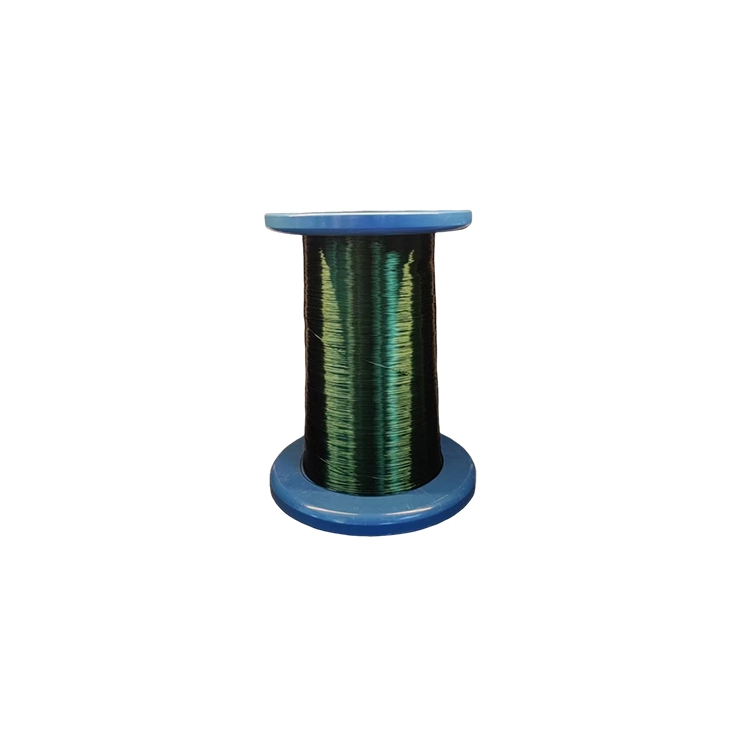
Copper is the most valuable material in a magnet wire factory, and the enamel that makes the wire useful is also what makes it hard to recycle. Between those two facts sits a set of practices that determine how much material a plant actually recovers and how much becomes waste.
This update covers what we do with enameled wire scrap, how conductor recovery works in practice, and the questions a buyer should be able to ask any magnet wire supplier — because sustainability claims in this industry range from well-documented to entirely unverifiable.
Where Scrap Comes From
Enameled wire production generates recoverable material at several points, and they are not equivalent:
| Source | Material state | Recovery route |
|---|---|---|
| Start-up and run-out tails | Bare or lightly enamelled | Direct return to conductor stream |
| Off-spec finished wire | Fully enamelled | De-enamelling then conductor recovery |
| Winding and spooling waste | Enamelled | Segregated by alloy and recovered |
| Conductor drawing scrap | Bare | High-value clean scrap |
| Customer returns | Enamelled, mixed | Segregated and processed by alloy |
The economics and the environmental outcome both depend on segregation. Enamelled copper scrap is worth materially less than clean bare copper, and mixed alloys — copper, aluminium and CCA in one bin — attract the lowest value and the least reliable recovery. Sorting at the point of generation is the single highest-value practice in the whole process.
How Conductor Recovery Works
Removing enamel from wire is not a single technology; it is a choice with different trade-offs, and the choice matters if you care about the environmental result rather than only the recovered metal:
| Method | Principle | Trade-off |
|---|---|---|
| Mechanical stripping | Abrasion removes the film | Low energy; suitable for coarser gauges only |
| Thermal de-enamelling | Controlled pyrolysis burns off the polymer | Effective on all gauges; energy intensive; off-gas must be treated |
| Chemical stripping | Solvent or molten-salt attack | Thorough; chemical handling and effluent control required |
| Direct remelt with slag management | Enamel burns off in the furnace | Simple; risks metal loss and higher emissions without control |
For fine enamelled wire, thermal processing with properly controlled off-gas treatment is the practical route. The environmental case for recycling holds only if the emissions from removing the enamel are controlled — an uncontrolled burn recovers copper at an environmental cost that can outweigh the benefit of the recovered metal.
Reducing Waste Before It Is Created
Recovery is the second-best option. Prevention is better, and in enamelling it comes from a small number of process disciplines:
- Tighter process control — stable oven temperature and line speed reduce off-spec generation far more than any end-of-pipe measure.
- Scheduling by diameter family — grouping similar gauges reduces changeover tails and start-up waste.
- Right-first-time sampling — a clear approved specification reduces repeated sample runs.
- Spool and packaging reuse — returnable and reconditioned spools cut packaging material and cost simultaneously.
The first of these is worth emphasising because it serves the buyer directly. A plant that generates less off-spec wire is also a plant that ships more consistent wire. Waste reduction and quality improvement are the same project.
Energy and Process Emissions
Enamelling is an energy-intensive process — the wire passes through a curing oven, often multiple times. Meaningful reduction comes from:
- Heat recovery from oven exhaust to pre-heat incoming air.
- Solvent handling and recovery, or conversion to lower-solvent enamel systems where the specification allows.
- Line speed optimisation, which reduces energy per kilogram rather than only per hour.
- Measurement — you cannot reduce what you do not meter, so sub-metering the ovens is the prerequisite for any credible claim.
We operate under ISO 14001 for environmental management, which requires documented objectives, measurement and review rather than a one-off statement.
Questions to Ask Any Magnet Wire Supplier
Sustainability claims in this industry are easy to make and hard to verify. Six questions separate a documented programme from a marketing position:
| Question | What a credible answer looks like |
|---|---|
| Is your site ISO 14001 certified? | A certificate number and issuing body, verifiable |
| How is enamelled scrap segregated? | A description of sorting by alloy at point of generation |
| What happens to the enamel removed from recovered copper? | A named process with off-gas or effluent control |
| Do you sub-meter oven energy? | A yes, with a stated metric such as kWh per tonne |
| What is your off-spec rate and trend? | A figure with a direction, not a range |
| Can you supply RoHS and REACH declarations per shipment? | Documents tied to the batch, not a generic statement |
Any supplier operating a genuine programme will answer all six without hesitation. The absence of a certificate number or a named recovery process is itself informative.
What Buyers Can Do
The leverage sits in three places. Specify returnable or reconditioned spools where logistics allow — it reduces packaging waste and your own disposal cost. Consolidate orders by diameter family, which reduces the supplier's changeover waste and typically improves your price. And ask for the documentation: a supplier who is asked for environmental evidence repeatedly will maintain it.
Need sustainability documentation with your magnet wire order? We are certified to ISO 9001 and ISO 14001 and issue RoHS and REACH declarations per shipment, with batch-level traceability. Ask us for our environmental management details alongside your technical quotation.