
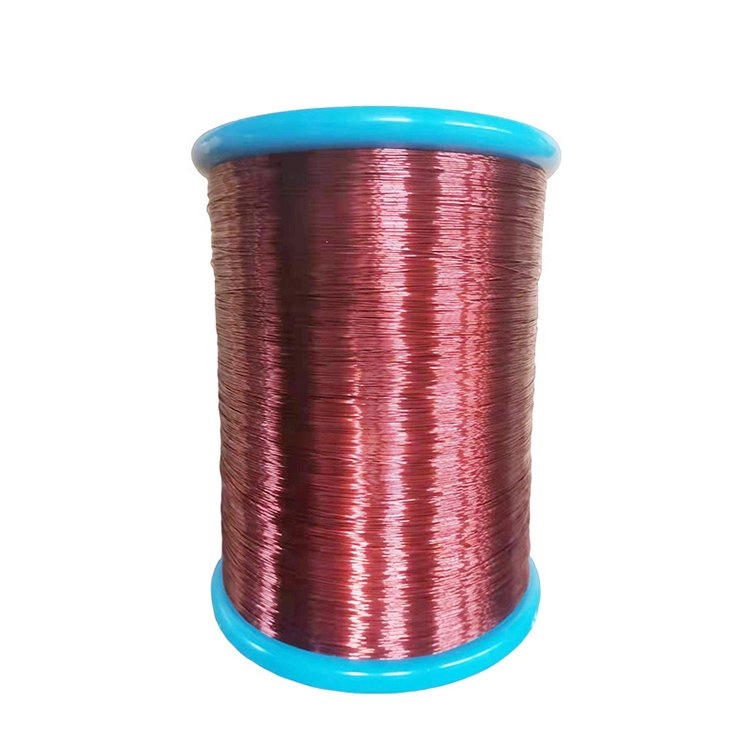
Industrial pumps and compressors are among the most demanding duty cycles a magnet wire will see. They start under load, run continuously, and in the hermetic case sit inside an atmosphere of refrigerant and lubricant for a service life measured in years. This case study works through a specification problem on a compressor application and the change that fixed it.
The application details are presented in generalised form; the engineering reasoning is the transferable part.
The Application
| Parameter | Value |
|---|---|
| Equipment | Hermetic scroll compressor |
| Rated power | 11 kW |
| Supply | Three-phase, inverter driven |
| Motor type | Permanent-magnet synchronous |
| Winding environment | Sealed, refrigerant and POE lubricant atmosphere |
| Design duty | Continuous, high ambient |
| Annual production | Medium volume, multiple frame sizes |
The starting point was a 180 °C class polyester-imide (EIW) build on copper round wire — an entirely conventional choice for a compressor motor, and the right one for many such designs. The problem emerged in the field after approximately 18 months of service, as a series of winding failures on units in high-ambient installations.
The Field Failure
Failed units were returned and sectioned. The findings were consistent across the samples:
- Breakdown initiated at the slot exit and at the phase-to-phase crossover points rather than in the slot body.
- Localised discolouration of the enamel around the failure site, indicating a thermal event preceding the electrical breakdown.
- Loss of adhesion in the affected zones — the film had debonded from the conductor and from adjacent turns.
- No evidence of mechanical damage from winding or insertion; the coil geometry was correct.
The pattern — failure at the ends of the slot, preceded by a hot spot, with adhesion loss — points away from a manufacturing defect and toward a thermal and chemical degradation mechanism at the winding's hottest points.
Root Cause Analysis
Three contributing factors emerged, and it is their combination rather than any single one that caused the failures.
Factor 1: Inverter-Induced Local Heating
The motor is inverter driven. Fast voltage transitions concentrate stress at the winding ends, and the local current distribution at slot exit raises the local temperature above the winding-average figure the design assumed. A class 180 insulation has less headroom at that local hot spot than the bulk temperature calculation suggested.
Factor 2: Refrigerant and Lubricant Exposure
Inside a hermetic compressor the enamel is in permanent contact with refrigerant and POE lubricant at elevated temperature. Over time this environment attacks the polymer film — first reducing its flexibility and adhesion, then degrading dielectric strength at the points already thermally stressed.
The interaction matters: either factor alone might have been survivable. A cooler winding would tolerate the chemical exposure longer; a chemically inert film would tolerate the hot spot. Together they compounded.
Factor 3: Adhesion Loss as the Accelerant
Once adhesion was lost, the film could no longer resist the mechanical movement of turns under thermal cycling and electromagnetic force. Micro-movement at the slot exit created abrasion sites, and the failure followed from there. Adhesion retention is therefore not a secondary property in this application — it is a primary life limiter.
The Specification Change
The revised specification moved on thermal class, base-coat chemistry choice and a specific viscosity requirement for bonding to slot insulation.
| Element | Original | Revised |
|---|---|---|
| Thermal class | 180 °C (class H per the old design) | 200 – 220 °C |
| Construction | Polyester-imide (EIW) on copper | Polyamide-imide based high-temperature build |
| Conductor | Copper round, 1.00 mm | Copper round, 1.00 mm (unchanged) |
| Insulation build | Grade 2 | Grade 2 |
| Key properties verified | Breakdown voltage, elongation | Breakdown, elongation, adhesion, thermal class, refrigerant compatibility |
| Documentation | Routine test report | Routine report plus thermal-class and compatibility evidence |
The conductor was deliberately left unchanged. Altering the diameter would have changed the slot fill, the winding parameters and the motor's magnetic design — a far larger project than the failure justified. The problem was insulation, so the insulation was what changed.
Verification Before Release
The revised specification was not released to production on the basis of a data sheet alone. The verification sequence was:
- Routine electrical and dimensional testing of the new build against the specification.
- Adhesion and flexibility testing, with comparison against the original build under the same conditions.
- Thermal class verification by the applicable IEC 60317 method.
- Refrigerant and lubricant exposure trials followed by electrical retest.
- Wound-motor endurance testing under representative thermal cycling and inverter drive.
- Field trial on a limited batch in the high-ambient installations where the failures had occurred.
The field trial was the decisive step. Laboratory exposure testing narrows the candidate list; only representative field conditions confirm that the interaction of thermal and chemical factors has actually been addressed.
Outcome and Transferable Lessons
The revised build completed the field trial without recurrence, and the specification was extended across the frame-size range. Three lessons transfer directly to other pump and compressor applications:
| Lesson | Why it generalises |
|---|---|
| Design for the hot spot, not the average temperature | Inverter duty always concentrates stress at winding ends |
| Treat the winding environment as a chemical exposure | Hermetic and semi-hermetic motors are permanently immersed |
| Verify adhesion retention explicitly | It is the property that fails first and causes the most damage |
| Change one variable at a time | Conductor and insulation changes together make the result uninterpretable |
For open industrial pumps and compressors, the chemical factor is absent but the thermal one is not. The same first two lessons apply, and a high-temperature build is often the more economical choice once the cost of a field failure — including the service callout, the replacement unit and the customer relationship — is included in the comparison.
Specifying wire for a pump or compressor motor? Tell us the equipment type, duty cycle, inverter details and whether the winding is hermetic. We will recommend the thermal class and construction, and supply the test evidence — including adhesion and thermal-class verification — that supports the choice.